

5th February 2026

Highspeed Media
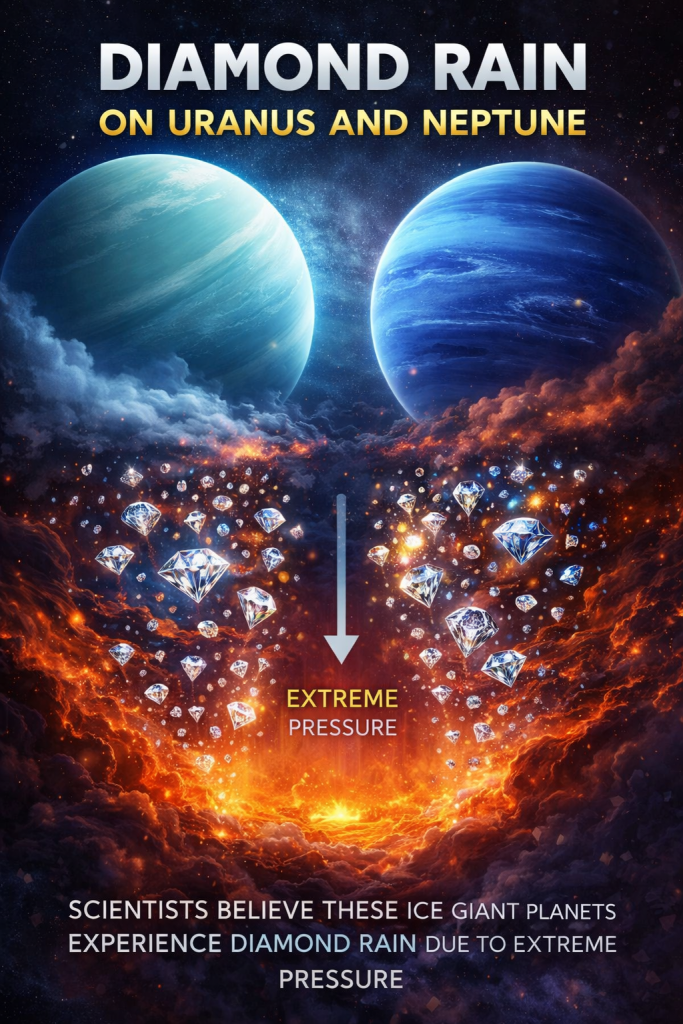
Among the many wonders of our Solar System, one of the most striking and counterintuitive ideas is that deep within the atmospheres of the distant ice giants Uranus and Neptune, it may literally rain diamonds. This isn’t science fiction it’s a scientific hypothesis built from decades of theoretical models, laboratory experiments, and planetary science research.
These two planets located billions of kilometers from the Sun are known as “ice giants” because they are composed largely of elements heavier than hydrogen and helium, especially water, ammonia, and methane. These compounds, under Earth‑like conditions, would be liquids or gases, but under extreme pressure and temperature deep within these planets, they behave very differently.
What’s Inside Uranus and Neptune?
First, it helps to understand what makes these worlds different from Earth and even other gas giants like Jupiter and Saturn. Uranus and Neptune have:
- No solid surface like Earth. Beneath their thick atmospheres, pressure and temperature increase gradually until the environment becomes a dense, slushy mixture often described as a “deep ocean” of hot ices.
- A mantle layer rich in methane, a hydrocarbon compound. Methane has carbon the essential ingredient for diamonds bound with hydrogen.
- Pressures millions of times greater than Earth’s atmosphere at depth, and temperatures reaching thousands of degrees. These extreme conditions are key ingredients in the diamond‑formation process.
How Diamond Rain Could Form
At the heart of the diamond rain idea is a simple physical process: when carbon atoms are subjected to intense pressure and heat, they can rearrange themselves into the crystalline structure we call diamond. On Earth, this happens deep beneath the crust over geological timescales. But inside Uranus and Neptune, nature provides a far more extreme setup.
Scientists believe that as methane descends deeper into the planet where pressure and temperature rise the hydrogen atoms can be stripped away, leaving free carbon atoms behind. Under enough compression, these carbon atoms bond in a diamond lattice. Over time, these tiny diamond particles begin to fall downward through the planet’s interior much like raindrops falling through the sky.
The idea of diamonds falling within ice giants was first theorized decades ago based on models of internal planet composition and the behavior of hydrocarbons under pressure. The mathematics showed that at depths perhaps thousands of kilometers below the visible cloud tops, conditions would be right for carbon atoms to assemble into diamond crystals.
Laboratory Evidence: Bringing Planetary Interiors to Earth
Confirming this hypothesis requires recreating planet‑like conditions in the lab, which is no easy task. However, in recent years scientists have made significant progress.
At facilities such as the Linac Coherent Light Source (LCLS) at SLAC National Accelerator Laboratory and partner institutions, researchers have used high‑power lasers and shock‑wave experiments to simulate the intense pressures and temperatures found inside these planets. By blasting materials rich in carbon (such as polystyrene, a type of plastic similar in composition to hydrocarbons) with lasers and measuring the resulting chemical changes, scientists have directly observed carbon atoms forming diamond structures.
In these experiments, scientists notably observed that nearly every carbon atom in the original sample joined to form nanodiamonds tiny diamond crystals just a few nanometers across under extreme pressure. On Uranus or Neptune, with thousands of years and much larger volumes of material, such diamonds could grow to considerable sizes, potentially weighing billions of carats.
Diamond Sinks, Planetary Dynamics
Once formed, these diamonds don’t just stay suspended. Because diamond is much denser than the surrounding fluid-like materials in the mantle, the crystals would sink inward toward the planetary core. In the most extreme models, this falling of diamonds could create a vast “diamond layer” deep inside the planet.
Some researchers suggest the falling diamonds could interact with other materials carrying gas and ice with them as they descend and might even help generate the complex magnetic fields seen around Neptune and Uranus. Unlike Earth, where magnetic fields are generated by metallic iron in the core, the ice giants’ irregular magnetic fields likely originate from a dynamo effect caused by conductive layers of material deeper inside. The currents driven by diamond rain could play a role in that process.
Voices from the Scientific Community
Researchers stress that while the idea of diamond rain is strongly supported by theoretical and experimental work, it still remains a scientific model rather than a directly observed phenomenon, because no probe has yet sampled the interior of these distant planets. Space missions to Uranus and Neptune are rare, with the only close encounter so far coming from NASA’s Voyager 2 spacecraft in the 1980s.
Still, the combination of mathematical simulation, high‑pressure experiments, and consistent planetary modeling has made the diamond rain scenario one of the most intriguing predictions in planetary science. If correct, it would not only reveal something spectacular about our own Solar System but might also inform our understanding of thousands of exoplanets beyond it many of which appear to be similar in size and composition to Uranus and Neptune.
Why It Matters
Beyond its sheer poetic allure imagining chunks of diamond falling through alien skies the diamond rain hypothesis gives scientists a tool for understanding planet formation, interior composition, and even magnetic field generation on planets very different from our own. It challenges earth‑centric assumptions and shows how widely the laws of physics play out in nature’s grand laboratory of the cosmos.
In the future, planned missions to the outer Solar System could provide further data to test these ideas directly, but for now, diamond rain stands as a vivid example of how experimental physics and astronomical theory can intersect to reveal astonishing truths about worlds far beyond our reach.



तपाईको प्रतिक्रिया