

26th February 2026

Highspeed Nepal
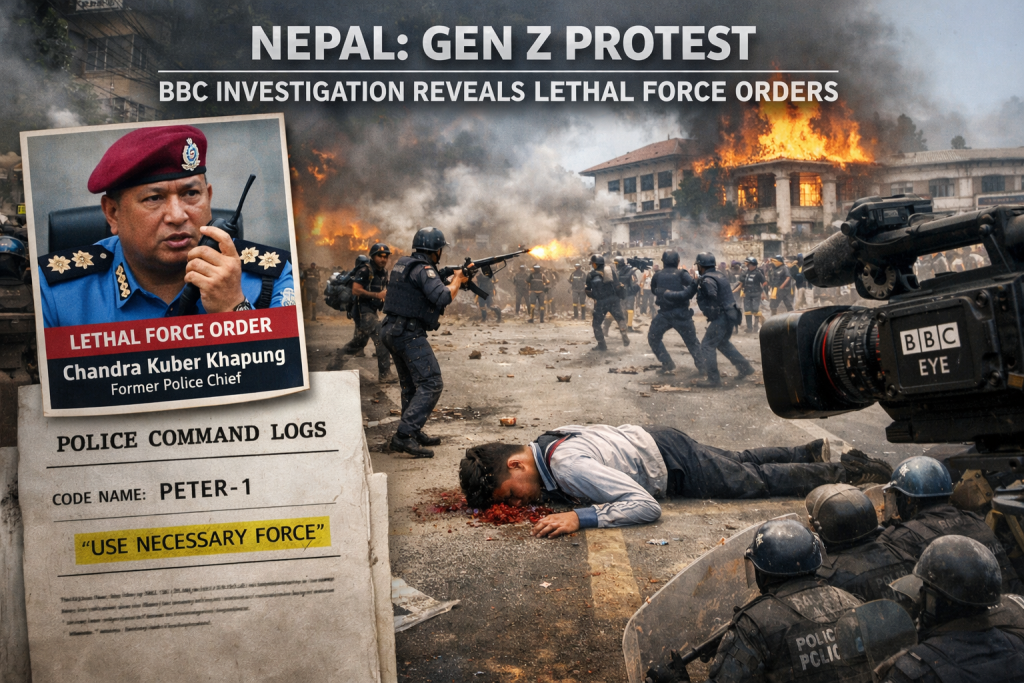
An independent investigation by the BBC World Service’s investigative unit has uncovered new internal evidence showing that a high-ranking police official ordered the use of lethal force against largely unarmed Gen Z protesters during the violent demonstrations in Kathmandu on 8 September 2025 a day that became one of the deadliest episodes in Nepal’s recent political history.
Orders From Police Command
The BBC documentary aired in both English and Nepali analyzed leaked Nepal Police communication logs, internal documents, eyewitness video footage, and interviews with officers and protesters. According to the investigation, an officer identified only by the call sign “Peter 1” instructed police officers to “deploy necessary force” roughly ten minutes after a curfew came into effect in central Kathmandu. Investigators say this directive came shortly after requests from officers on the ground for permission to escalate beyond tear gas and water cannon.
Sources familiar with the code say “Peter 1” referred to former Inspector General of Police Chandra Kuber Khapung, who has not denied issuing the order but has stated it followed approval from a government security committee. The documentary suggests there remains confusion and disagreement over who exactly authorised the use of live ammunition.
Casualties and Graphic Evidence
The BBC team reviewed verified video evidence showing multiple fatal shootings. Among the victims was 17-year-old Shreeyam Chaulagain, who was reportedly unarmed and walking away from the protest when he was shot in the back of the head a detail underscored early in the documentary.
At least 19 protesters were killed on that day in clashes with security forces, with dozens more injured, according to police logs and independent estimates. Large crowds of young demonstrators had taken to the streets to protest political corruption, alleged nepotism, and the government’s ban on major social media platforms earlier in September.
Sequence of Events
According to the BBC’s reconstruction:
-
Tens of thousands of predominantly Gen Z activists gathered outside the Federal Parliament complex in Kathmandu.
-
A curfew was imposed around midday, but protests continued.
-
Shortly after the curfew began, the “Peter 1” directive was issued.
-
Security forces then deployed live ammunition against the protesters, resulting in numerous fatalities and serious injuries.
Following the shootings, the unrest escalated nationwide. Police stations and government facilities were attacked, and several officials were injured or killed in retaliatory violence. On 9 September 2025, then Prime Minister KP Sharma Oli resigned amid mounting pressure, leading to a political shake-up.
Ongoing Inquiry and Accountability
A public inquiry into the September 8 violence is currently underway in Nepal, but the BBC documentary highlights that no senior official has yet been held legally accountable for the orders that led to the deaths. Families of the victims continue to demand transparency and justice.
Documentary Impact
The documentary has reopened debate in Nepal about use of force standards, crowd control protocols, and command responsibility during large-scale political demonstrations. The BBC reported that the findings were based on exclusive access to communication logs and witness testimony that had not previously been made public.



तपाईको प्रतिक्रिया